AI Product · 0→1 · Startup · Accessibility
Parkey: an AI interpreter for confusing parking signs
Photograph the sign, get a clear yes or no
Role
Product Manager, Brand & Product Designer, Front-End Developer, Marketing
Where
Parkey (own startup)
When
2024
Status
Shipped as a startup minimum viable product (MVP)
TL;DR
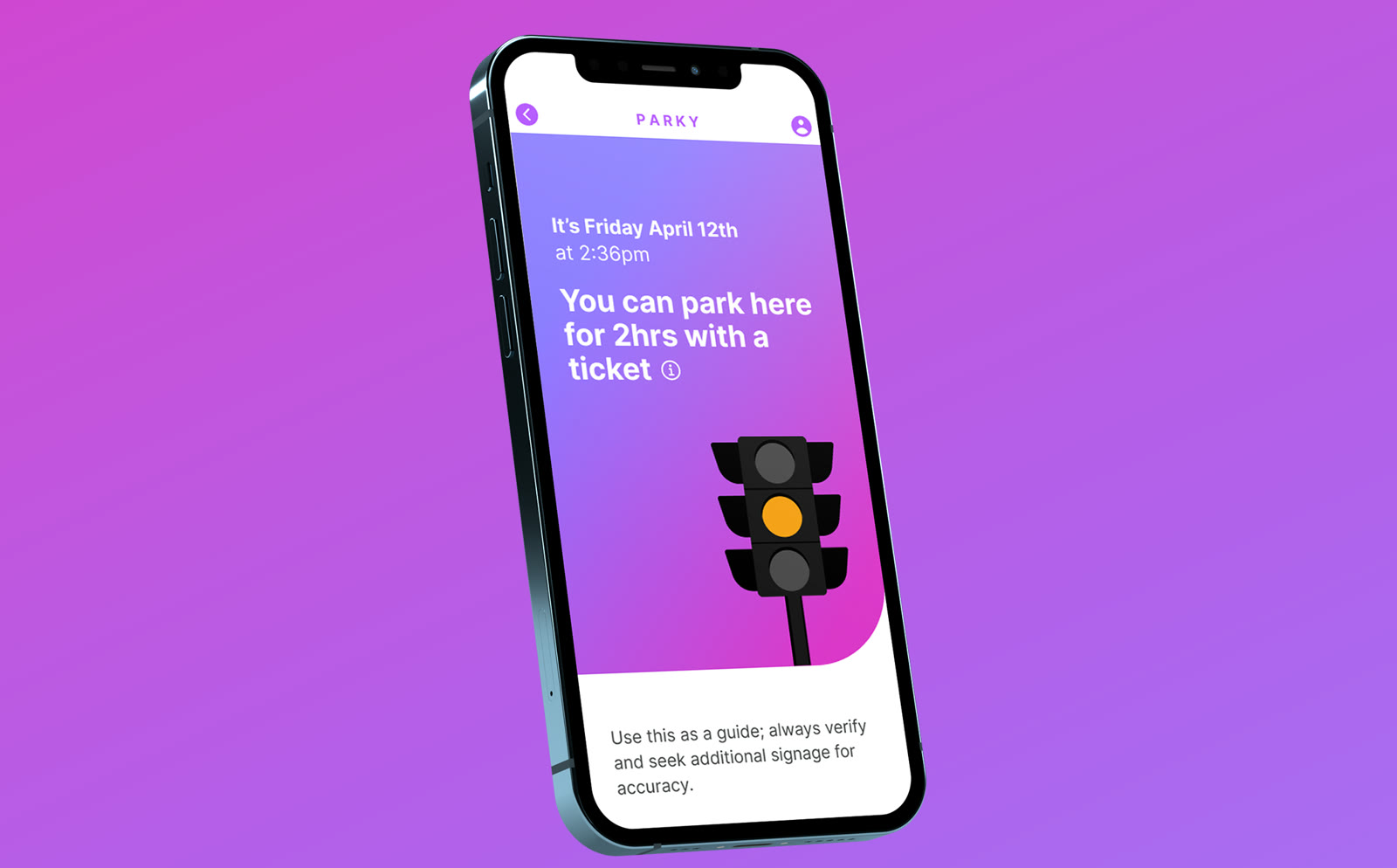
Parkey is a mobile app that reads Australian parking signs for you. Point your camera at the sign, and it interprets the rules and tells you, in a simple traffic-light system, whether you can park there right now. I worked on this from inception as Product Manager, Brand and Product Designer, Front-End Developer, and Digital Marketing lead, alongside one Full Stack Engineer.
The problem
Sydney's parking signs stack multiple time windows, permit zones, and day-of-week exceptions onto a single pole, and getting the reading wrong means a fine. That's stressful for anyone, but it's worse for drivers who've come to Australia from other countries and aren't used to how our signage works. Our hypothesis was that generative AI, which is good at exactly this kind of unstructured, visual, rule-based interpretation, could turn a stressful guessing game into a clear answer.
What I built
A mobile app where the core interaction is: photograph the sign, get an answer. Under the hood, OpenAI's GPT-4 interprets the sign's rules and current time against the parking regulation, and the app returns a traffic-light status so the answer reads instantly, no paragraph of legal text to parse under time pressure. Two of the harder design problems were determining which side of the sign the driver was actually reading (signs read differently depending on which direction you're facing), and phrasing conditional permissions (permit-holders only between certain hours, say) so they're unambiguous to a non-native English speaker glancing at a phone screen.
Process
As the non-engineering half of a two-person team, I owned everything except the backend: product direction, brand identity (a bright, distinctive palette and a 3D "P" logo shaped like a parking sign), UI design in Figma, and the front end itself, built in React and Next.js with Emotion for the app and Tailwind for the marketing site. I also explored training a Gemini model as an alternative to GPT-4, and ran the early digital marketing, including an SEO-driven blog content strategy for the website.
Outcomes
Parkey shipped as a working MVP: a real app that photographs a sign and returns a clear parking verdict, built end to end by a two-person team from a standing start. It's the project that taught me the most about owning a product with no safety net, when there's no separate design team or marketing team to hand things to, every decision is yours and every gap is visible.
Blog
Get new posts by email
Real AI product research, agent builds, and what actually worked. Roughly monthly, never spammy.
Unsubscribe anytime.